36 posts

Day 10: Shooter & Programming

2013 FRC Build SeasonFIRST Robotics

shooterr

Shooter

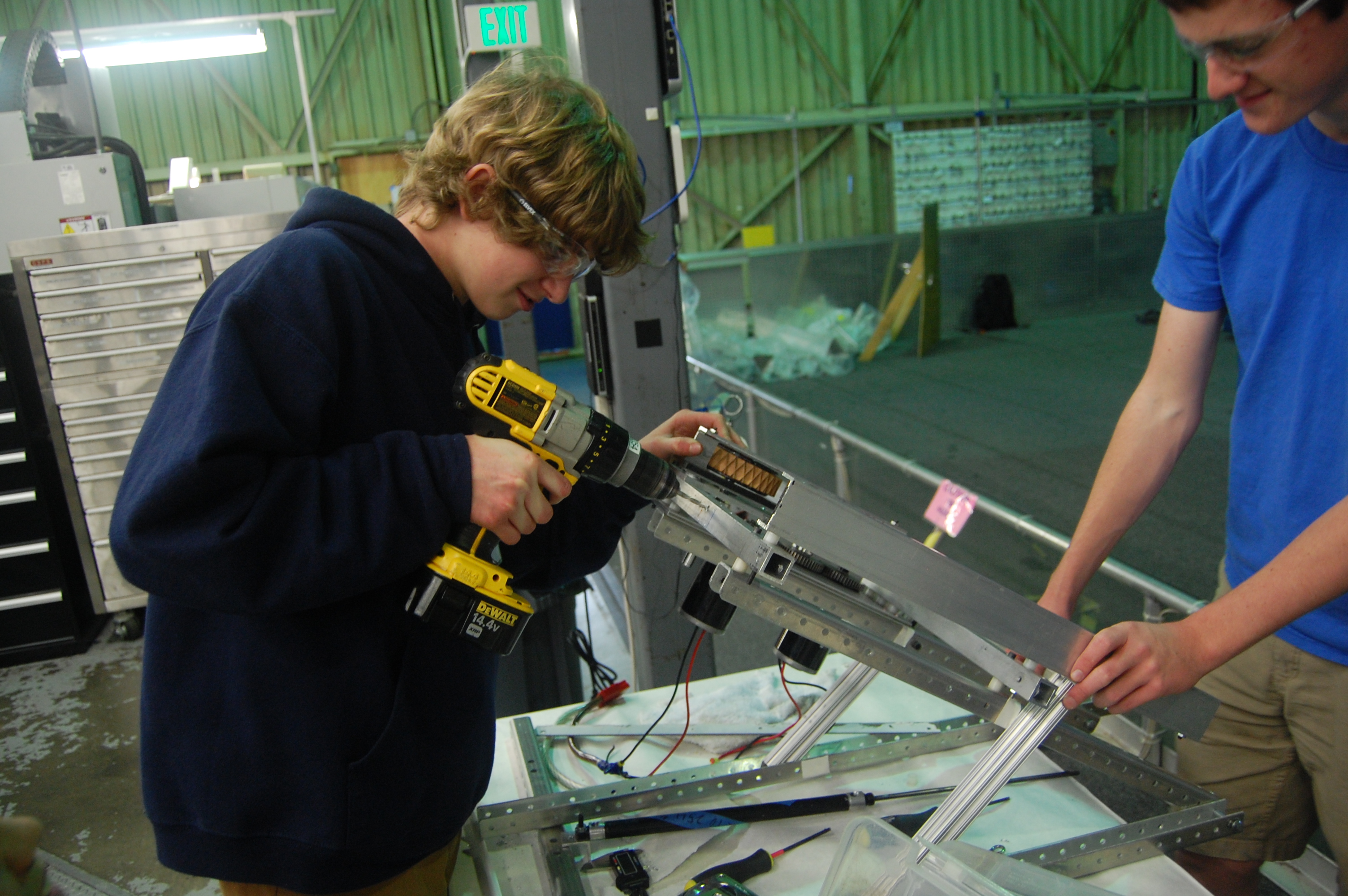
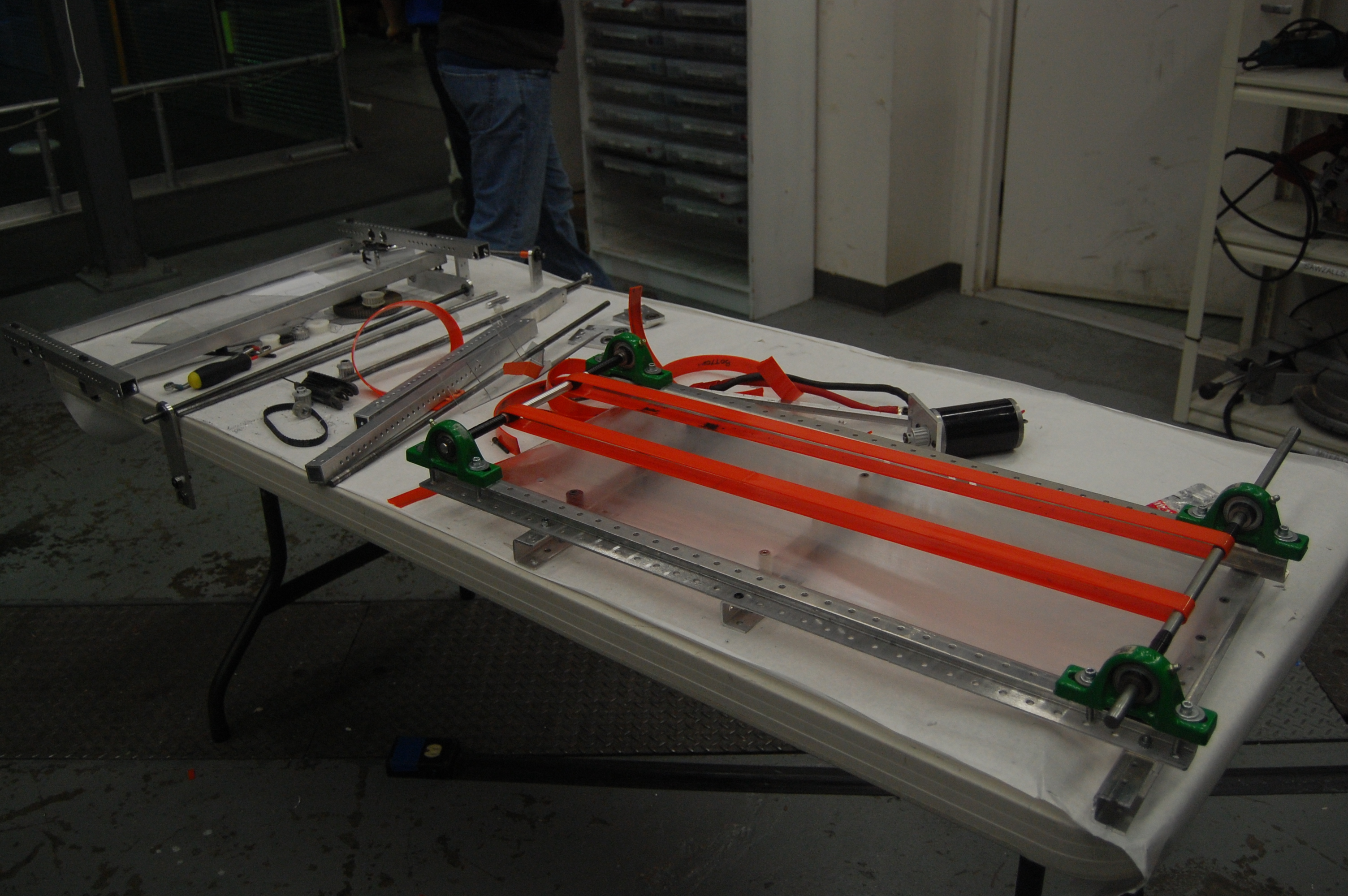
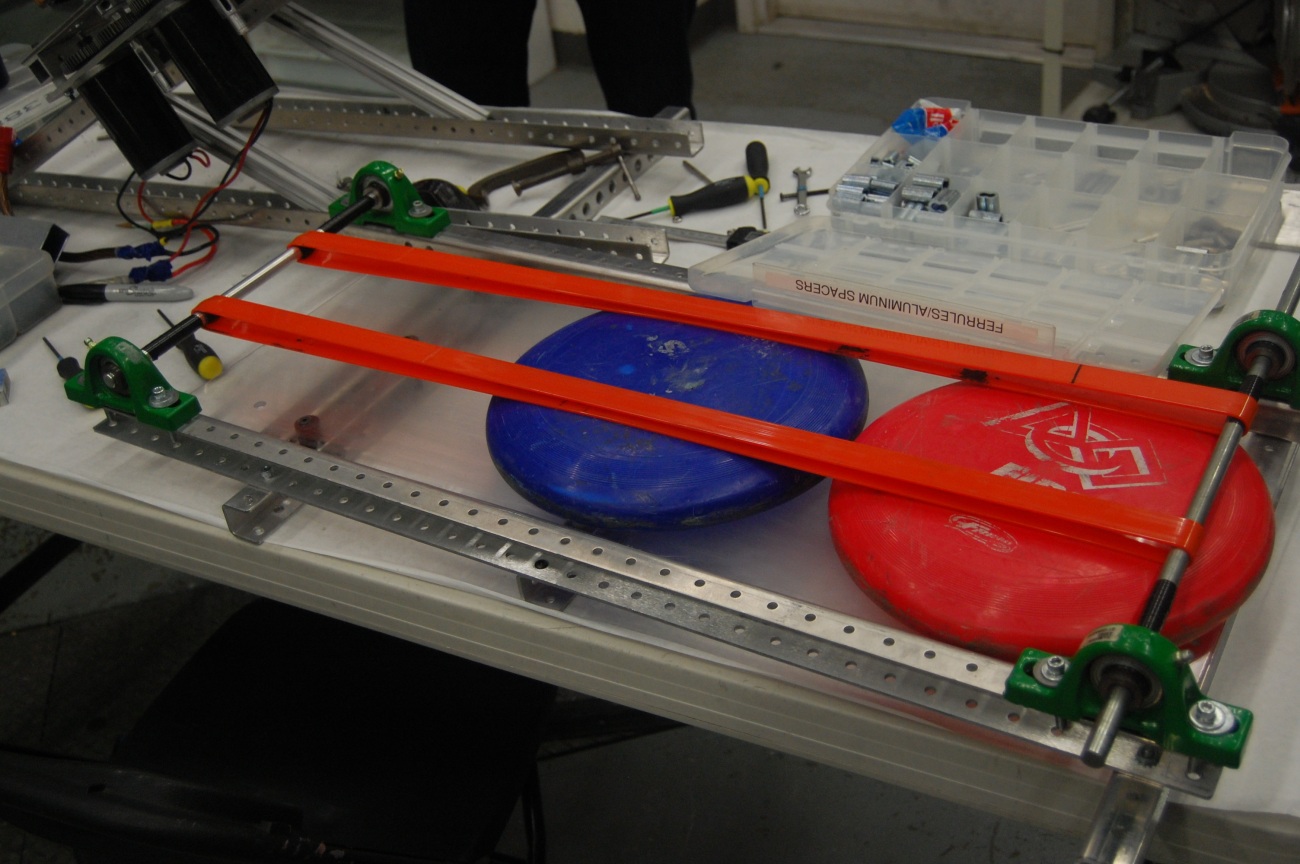
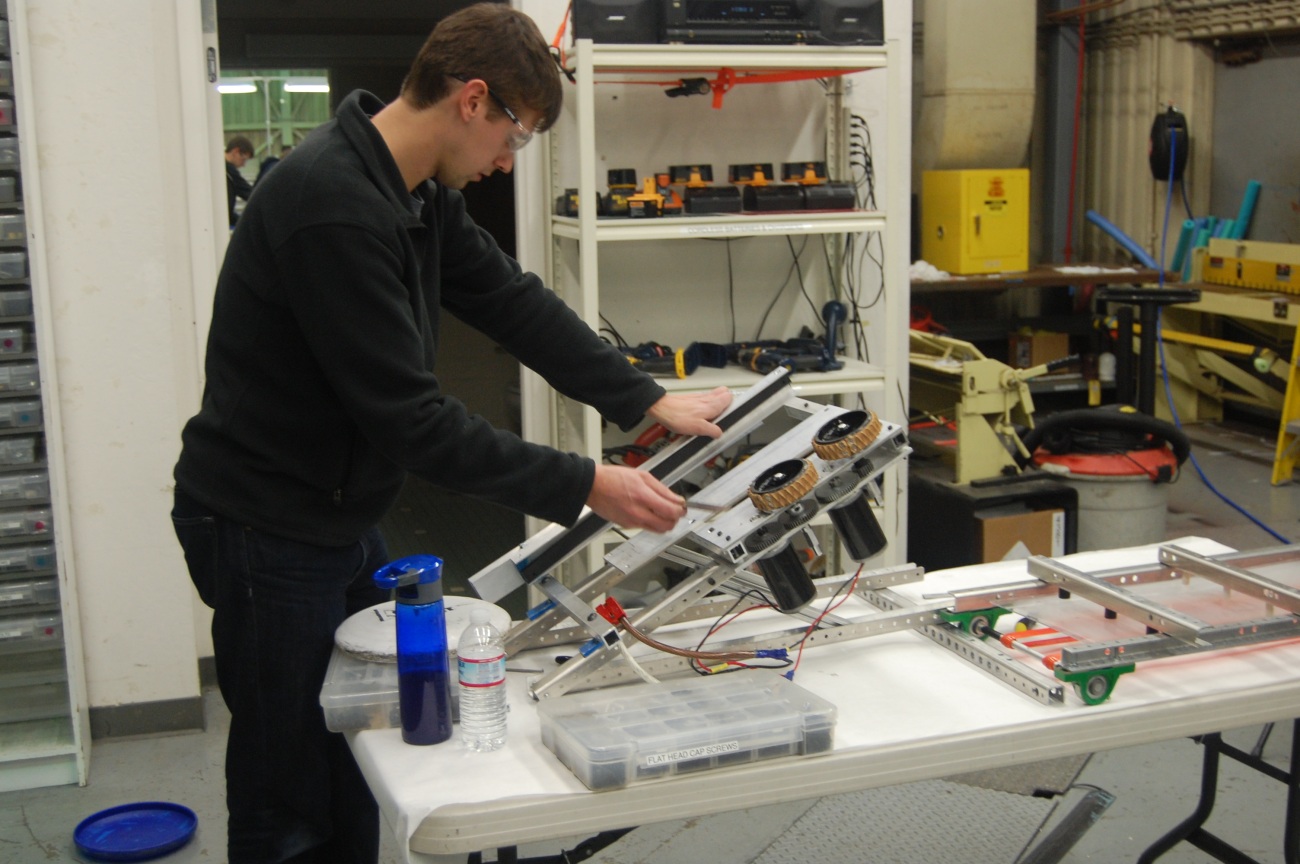
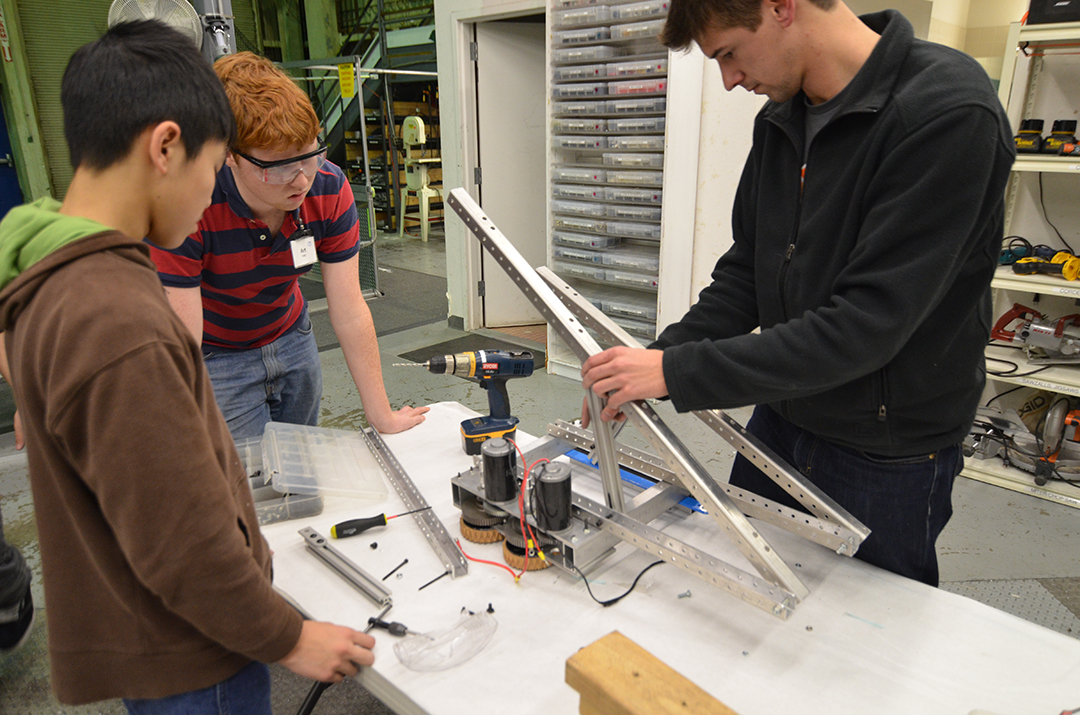
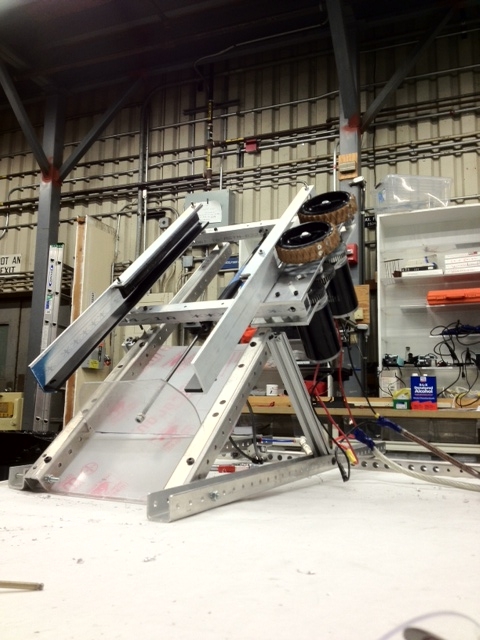
The shooter retained most of its current form in terms of design, some new pieces were just added on. A system for indexing and stacking frisbees was designed and implemented on the prototype shooter, so that it will be able to load several frisbees.

Programming

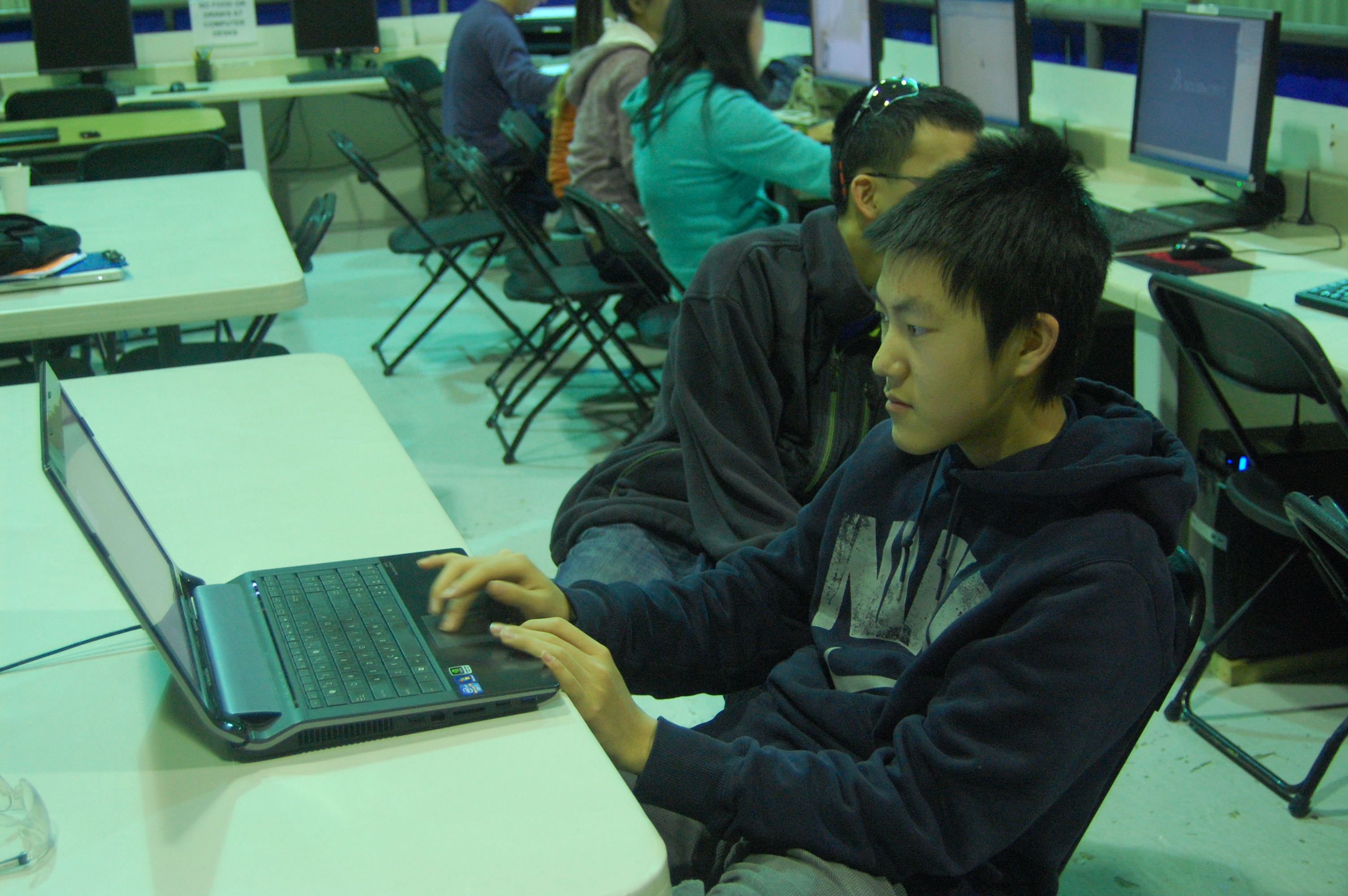
The programming team had an effiecient day today. Firstly, they worked on the autonomous script and selector.  The programmers hope to cycle between hard-coded and on-the-fly autonomous sequences with a press of a button.  Secondly, they worked on the Smart Dashboard and the GUI.  The team managed to get the FTP connection to work.  It turns out that the Apache Commons jar should be placed in the lib/ directory of the Smart Dashboard folder.  This has yet to be tested on the driver station laptop, which will be done tomorrow.  Finally, they started designing the control board and creating the corresponding list of parts.  The team decided on driver and operator controls, such as joysticks, buttons, and switches for the robot's functions.  Students also decided on the sensors that would go in the robot (encoders, gyro, etc).
Drive Gearbox

Design

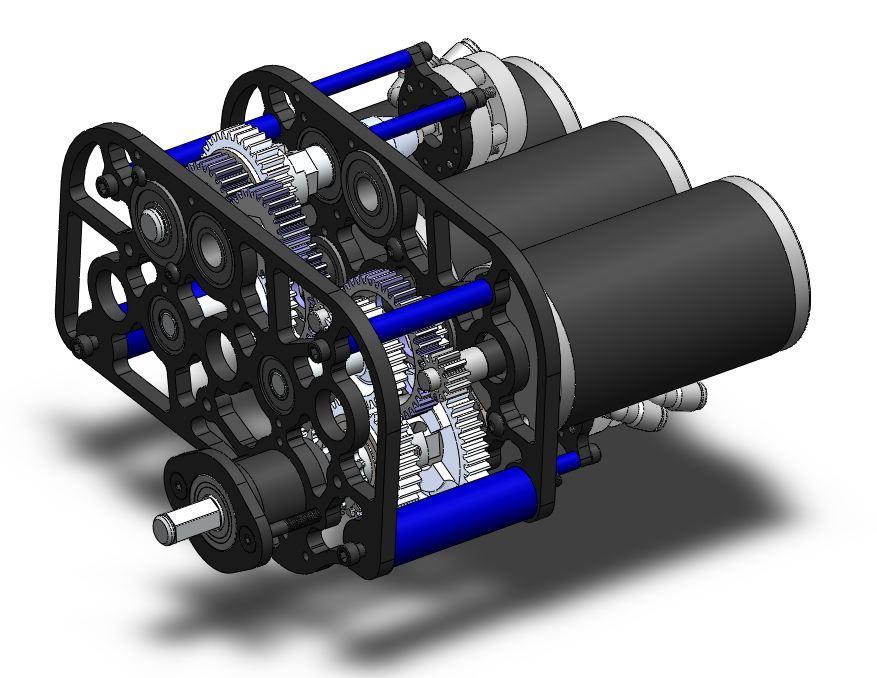
The design of the robot has been coming along slowly but steadily.  The team decided on a 6 motor drivetrain utilizing 6 CIM motors.  Furthermore, each drive gearbox has a Power Take-Off (PTO) which could be used later to power a hanging mechanism.

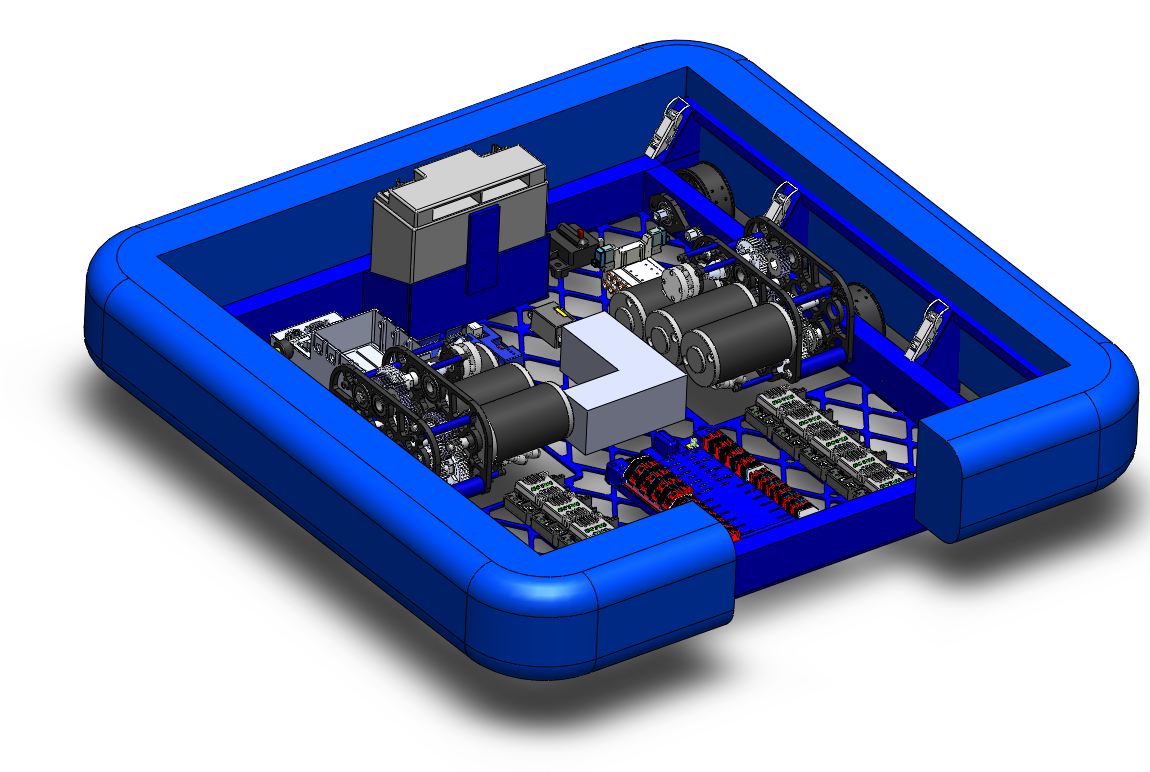
After intake prototypes illuminated potential difficulties bringing disks up such a steep angle, it was brought up that a wider robot would allow for a gap in the bumpers for frisbees to travel through. After a long discussion, this route was pursued and the drivebase weldment (assembly 254-13-A-0300) was finalized and the base plate was sent out for manufacturing by sponsor BAE Systems.
Drivebase

With the drivebase weldment finalized, students worked to make CAD drawings for the components of the weldment.  Furthemore, the control board design began.

Miscellaneous

The shipment from Coast Aluminum arrived. It was taken apart, checked and stored with the other aluminum. Some of it was cut to begin manufacturing a few of the smaller parts.

Action Items

  • Finish bumper design

  • Hold a design review for the helical conveyor/indexer

  • Begin prototyping the helical conveyor/indexer

  • Begin cutting drivebase stock 

  • Continue work on autonomous selector

  • Test uploading files from Smart Dashboard on driver station laptop
FRC Day-Off, Week 2

2013 FRC Build SeasonFIRST Robotics

Today was our first down day for FRC build. This post will recap a few of the design decisions and design progress so far.

Drivebase Configuration

There will be a square drivebase on the robot. This was decided up for the following reasons. The square configuration will give more room for the intake. One of the updated rules was that the the robot cannot exceed a 54" cylinder. Because of this, the shorter and wider robot will allow for more room in the intake to drop down.

image

Electronic Layout Done. Baseplate sent for manufacturing

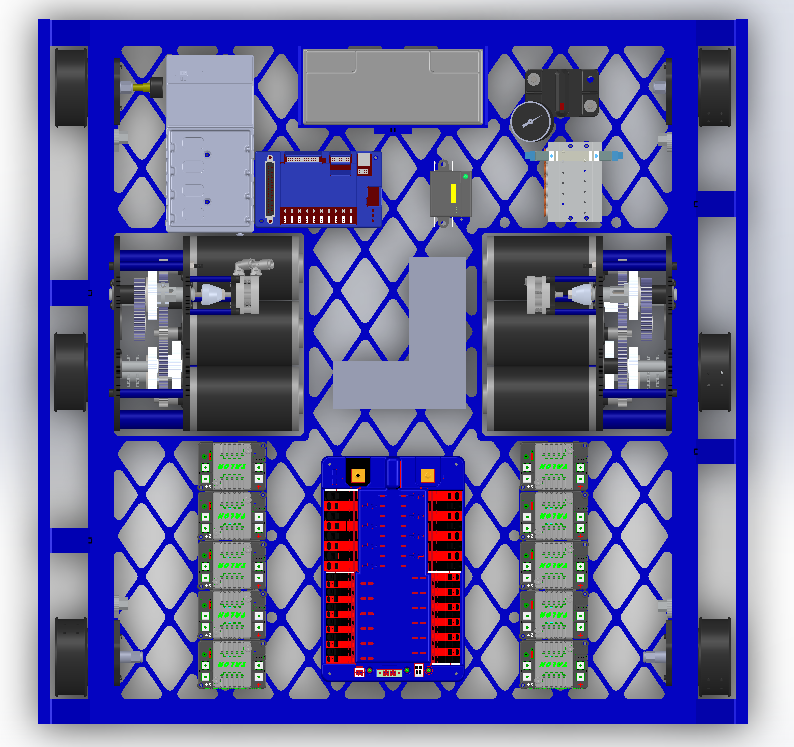
After finalizing the size and dimensions of our drivebase, the next step was to complete the layout of electronics on the baseplate. The batter will go towards the back of the robot (away from the intake) to balance out the center of gravity. The talon speed controllers will be at the front along with the power distribution board. These were all layed out in the CAD model and mounting holes were put in the baseplate. The raw material for the baseplate was cut and was sent to BAE Systems. The baseplate will get waterjetted by BAE and hopefully sent back by the end of the week.


See above for the electronics layout.

Cutout in Bumpers for Intake

It was decided that the bumpers will have a cutout to allow the intake to drop down. The intake will bring the frisbees over the frame rail, but not the bumper. Having the cutout will allow the intake to drop down on a pivot that is lower down. This will give the intake a smaller profile when pivoting down allowing for a bigger intake when fully extended.

Day #9: New Intake

2013 FRC Build SeasonFIRST Robotics#blog#FRC

Prototyping

Shooter

Students have made a couple of modifications to the shooter prototype.  An L channel was added, in addition to guide rails.  A pneumatic piston was attached to the shooter to load the frisbees into the shooter wheels.

The goal was to make a shooter that could shoot frisbees both upside down and right side up. After making the modifications and adding the "autoloader" the shots became more consistent (because of the same loading dynamics). However, the upside down shots and the right side up shots were aiming differently. The most significant difference is the flying dynamics. The upside down frisbees were more unpredictable and didn't fly as well.


DSC_9563

Students making enhancements to the shooter


Conveyor

Not much was changed on the conveyor.  Upon the completion of the shooter and intake, students will integrate the conveyor design with the two other prototypes.


DSC_9527

Conveyor prototype

New Intake

The team took a new route with the design of the intake.  They removed some of the orange polyurathane belts in the process.  A new intake was constructed from the CAD.  Though it works fairly well, the team is working on improving it.  It can't quite take two frisbees at the same, but can still pick them up quickly.  The design is based on the old conveyor prototype and old intake prototype.

At the end of the night, the intake was fully functional and was able to funnel two frisbees into one. It was also able to easily pick up the frisbee from the ground, albeit not as well as was hoped. The intake so far is not fast enough and not consistent enough. More work will be done on it tomorrow.


DSC_9531

Building the new intake


Programming

The programmers worked on a Smart Dashboard widget for writing constants and their values to a text file, and uploading them to the robot using FTP.  They first worked on the layout of the widget, and were successful in the writing and clearing functionalities.  However, the programmers still had issues creating an FTPClient object and connecting to the robot.


DSC_9549

Dorian Chan programming the Smart Dashboard widget


Students also wrote a Turn Command for use during autonomous mode.  The ScriptedAutoReader was configured to read the word "TURN" as a TurnCommand and appropriately create one.  It seems to work, but the command still requires extensive testing, since the command depends on the gyroscope and the robot was left on the stand.


DSC_9592

Richard demonstrating turning in real life

Miscellaneous

The pyramid was fixed.  The top goal of the pyramid was brought down for some adjustments, and then reattached.


DSC_9528

Fixing the pyramid goal

Action Items

  • Continue work on intake (make it work)

  • Make shooter accurate

  • Do math, save world

Lab closing time for the night was 2:00 AM

Build Season Begins

2013 FRC Build Season

D7K_3451The team is now a week into the short 6 week FIRST Robotics build season.  We've made a ton of progress on everything from design and prototyping to field construction and programming.  We have built the pyramid from the field drawings and have come up with a ton of concepts for various game challenges, some of which have been tested.  The programming team has been working to get old robots up and running both for programming practice and for testing prototypes.

D7K_3455

The team is in agreement that Ultimate Ascent, this year's FIRST challenge, is one of the harder games in recent FIRST history.  However, we're happy with the prototypes that we've been working on and are confident that we'll be able to pull together a robot to play the game.

Team 254 works on a different schedule than many other FRC teams, designing and manufacturing parts in parallel.  This forces us to design sequentially and finalize parts as soon as they are ready so they can be made in time.  For example, some robot parts were designed on day two and sent out to sponsors on day three of the build season.

D7K_3401As we move into week two, the focus is on continuing to prototype designs and trying to lock down some aspects of the robot design so that we can send more parts out to sponsors by the beginning of week three.  It'll be busy but we think we can do it.

Day #8: Really Consistent Shooter Prototype

2013 FRC Build SeasonFIRST Robotics

Prototyping

Intake Prototype

The intake was totally redesigned in Solidworks today.  The design features multiple sets of belts to move the frisbees around.  It uses belts on the bottom to increase the friction between the disc and the polycarbonate sheet.  In total, 11 belts need to be manufactured and welded.  The newly designed intake prototype is currently under development.


intakeproto

The conveyor prototype


louis

Welding the polyurathane belts for the new intake


mercadante

Making modifications to the intake roller

Shooter Prototype

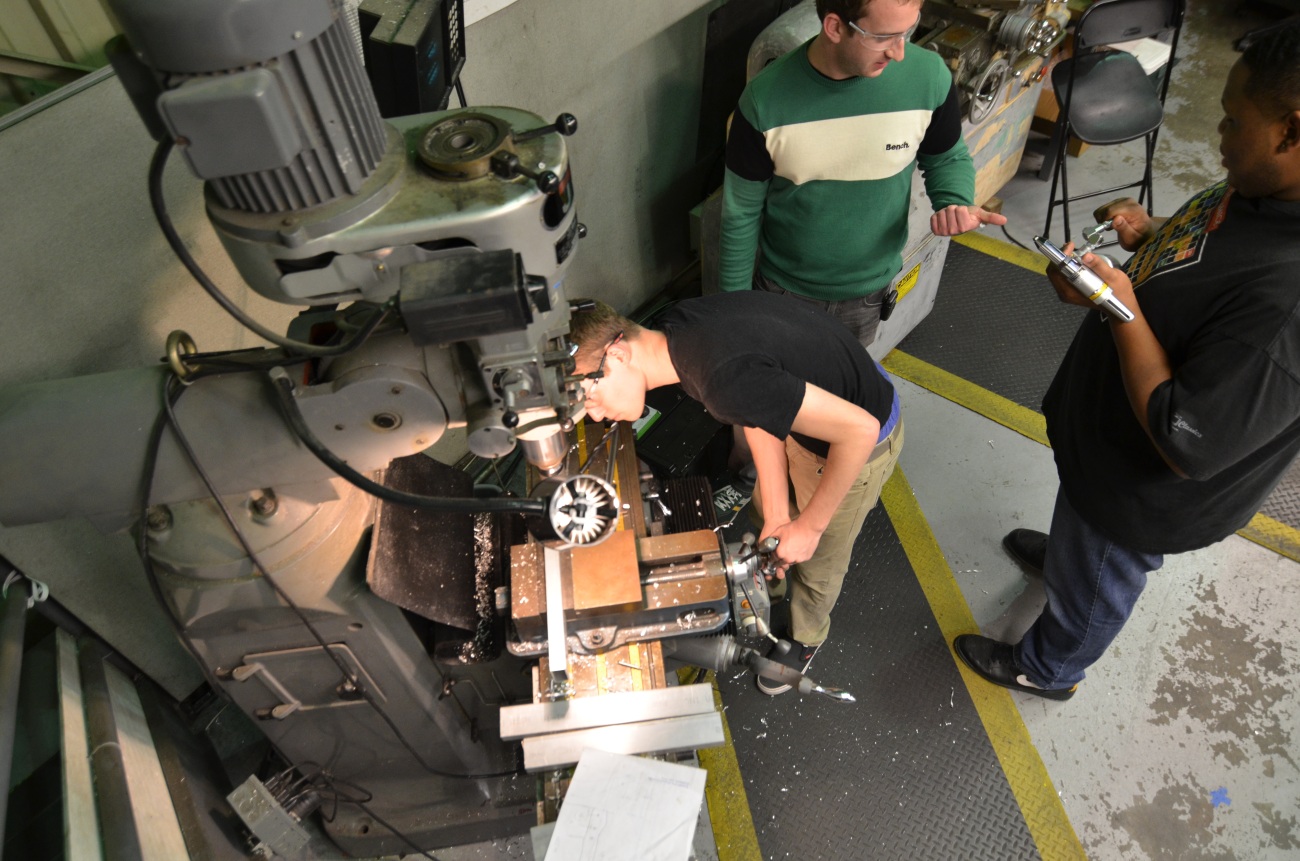
Students made changes and modifications to the shooter prototype.  C-channels were added on the left and right side of the prototype to guide the frisbee as it travels through the shooter's wheels, preventing it from moving upwards and adding stability.  In addition, new parts and attachments for the shooter were milled and manufactured.


shooterproto

The shooter prototype


The shooting prototype was tested extensively.  As the results show, the frisbees that were fired were somewhat accurate.  The orientation of the frisbee (upside-down vs. right-side-up) appears to have a slight influence on the trajectory of the frisbee.  An upside-down frisbee ends up at a smaller height than the height of a right-side-up frisbee.


2010 Robot

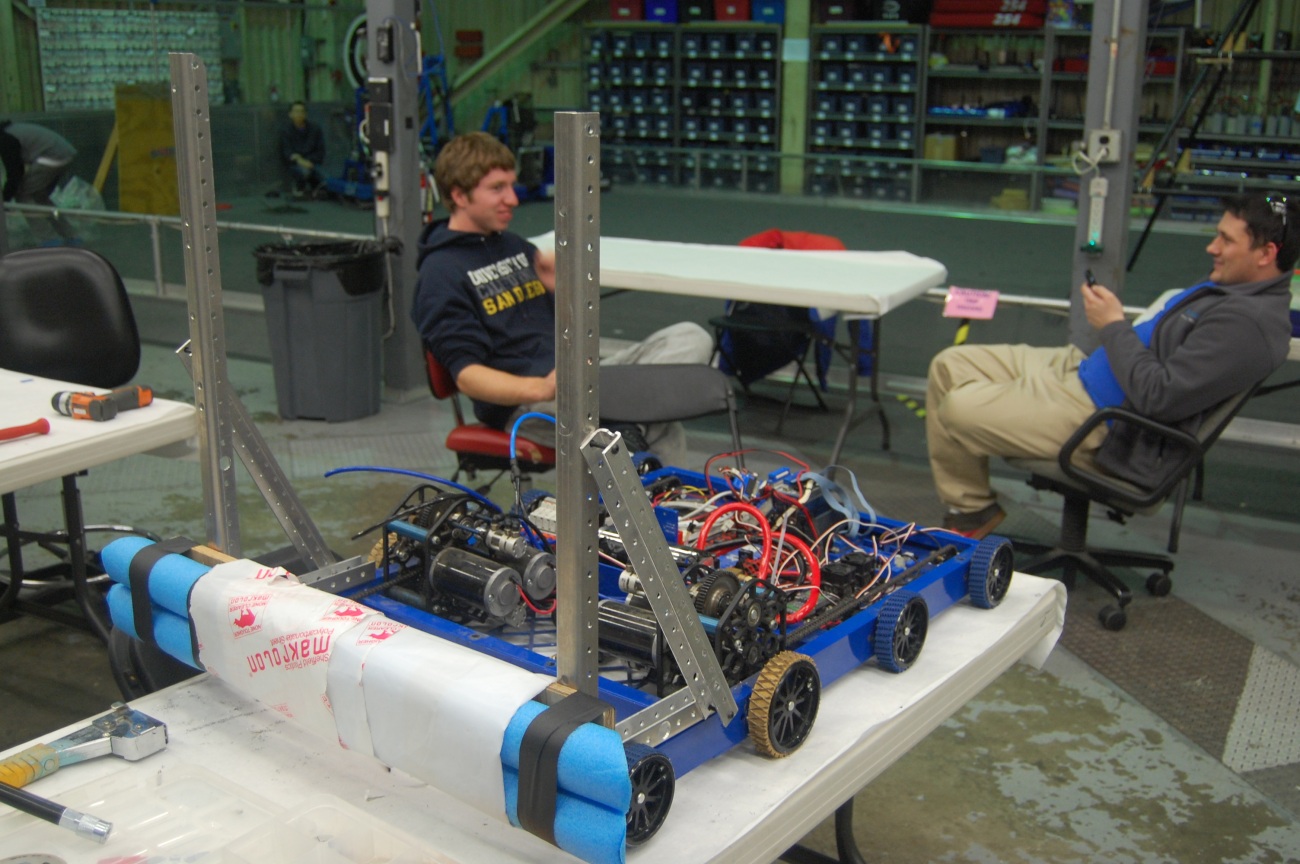
Makeshift bumpers were added to the 2010 robot today.  The bumpers were constructed out of pool noodles, which the students will use to create the real bumpers from later on.  The team hopes to use the 2010 robot's drivebase to attach and test the intake and shooter prototypes upon their completion.  Metal frames were also installed on the robot.  With these bumpers, students can test the intake mechanism as if it were on the real robot.


robot2010

The 2010 robot with bumpers and metal attachments

Programming

The programmers worked on a multitude of tasks today.  Some students worked on a custom Smart Dashboard widget that would populate a text file with a constant's name and value, then upload the file to the robot with FTP.  Currently, the widget is working, but students still have to investigate problems with the FTP connection.

Students also worked on automous command scripting.  With this, the robot can read autonomous commands from a text file on the robot, and execute them.  The benefit of this method is that the team won't have to re-compile or re-deploy the code in order to make one small modification to the autonomous.  Currently, the system is working as intended.  The robot was able to interpret the drive and wait commands.

Lastly, the programmers continued to work on reading constants from a file.  This has not yet been completed, but the students have a general idea and framework for what needs to be written.


programmin

Programmers programming


Pat Fairbank

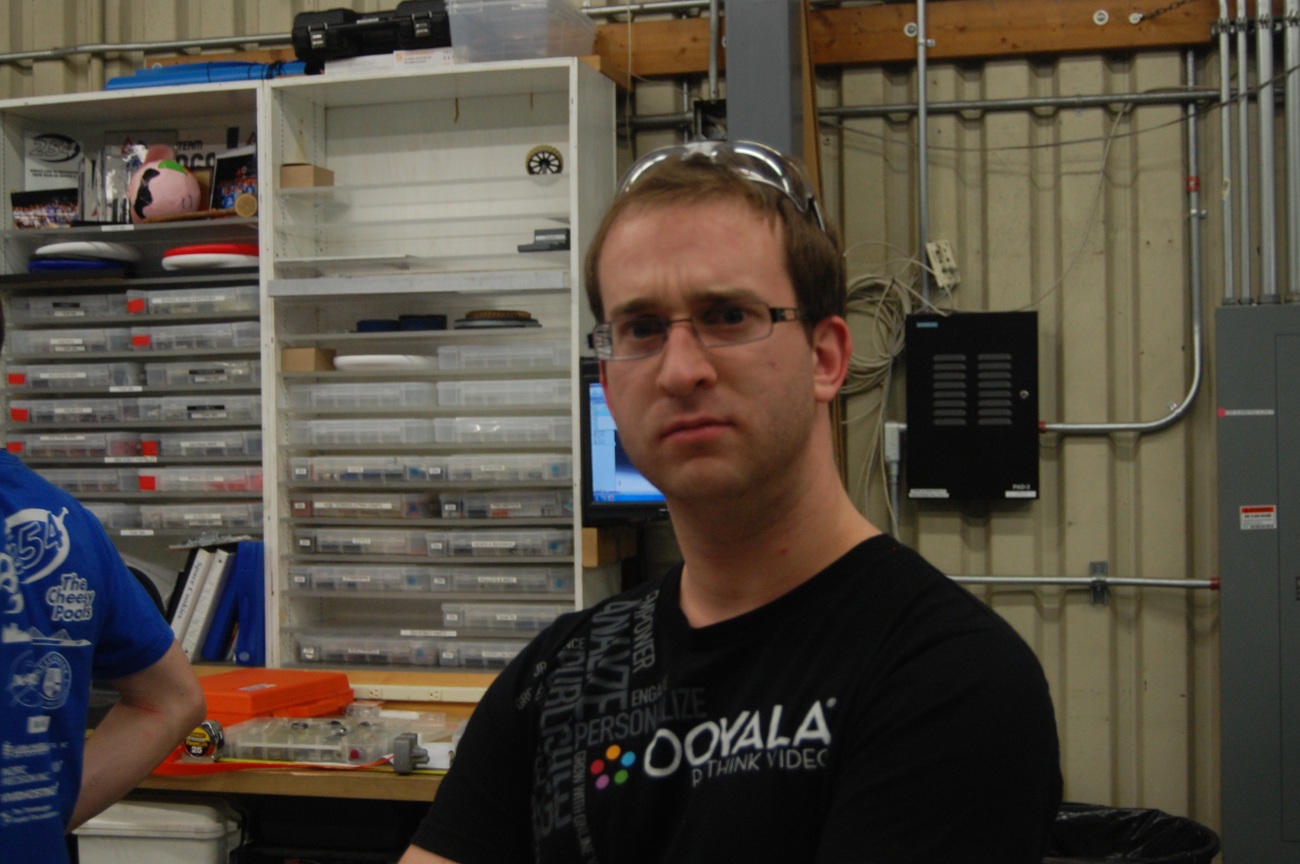
This is a prime example of our foremost Canadian mentor in his natural state of observation and intense thought about the world of robots.

pat

Pat being Pat

Action Items

  • Finish intake prototype

  • Mount said prototype to 2010 robot(onslaught)

  • connect all 3 prototypes and test from start to finish(Intake-Conveyor-Shooter)

  • Programming-work on reading constants from a file

Lab closing time was 12:50 A.M.

Day #7: Drive Base and Talon Testing

2013 FRC Build SeasonFIRST Robotics

Prototyping

Intake prototype

Students continued to improve on the Intake prototype. We wanted to have the Intake prototype powered by one CIM motor. We designed a system which utilized timing belts, gears, and an intermediate roller to power both the top and bottom rollers of the Intake. This is currently still a work in progress

Intermediate conveyor prototype

The team continued to refine the conveyer prototype. The team started out by opening up the new polyurathane belts that came today, and proceeded to brainstorm on how they could improve the conveyer. The team decided on three things.

  • Improved belts
  • A Compression device to hold the frisbees in
  • Counter Sunken Screws in said compression device

Improved Belts

The old system continued to have slippage with the timing belts, and thought the new polyurathane belts would solve this issue. The team cut the belts to the correct length, fused them together, and stretched them over the place where the old belts were.

Compression Device

The compression device solved the issue of the frisbee slipping off of the belts. The compression device consists of a piece of polycarb which has been sanded down for reduced friction. The polycarb is drilled down 1.3 inches above where the frisbee sits, holding it to the belts

Counter Sunken Screws

The new compression device posed a new problem, screws sticking out of it, holding the frisbee back from free movement. The team solved this issue by using a technique called countersinking, where a divet is drilled around the area of the screw, allowing it to rest out of harms way. This completely solved the issue of the frisbee getting stuck.

Shooter prototype

  • The 1x2 tubing was replaced with 1x1 tubing in order to raise the wheels higher so that they would contact the disc in an upside down orientation.
  • The length of the bottom plate was increased to increase consistency when loading the disc
  • The left side wall was shortened to try and make the discs go straight instead of off to the right.
  • The stand for the shooter was improved such that it sits flat without being held down.
During testing we made the following conclusions:
  • Shooting upside down was very inaccurate because even with raised wheels, the wheels still push the disc up.  U-channel needs to be added on both sides to keep the disc in line.
  • With the shortened left side wall, the discs did not fly straight, they flew to the right.  With U-channel added on both sides, and past the wheels, the discs should fly straight as they exit the shooter.

Programming

Then programmers updated the 8-wheel 2010 drive base to work with Talons. It will be used to mount the prototype intake and shooter. The team also made the robot controllable with the Logitech gamepad. A few members and mentors drove the robot around the field with the new controller. There is no new progress on the constant file reading system nor the autonomous command system.

Tomorrow, the programmers will work on the autonomous command system, the gamepad controls, and constant file reading.


Lab closing time was 12:30 AM

Day #6: Consistent Shooting Prototype

2013 FRC Build SeasonFIRST Robotics

Design

Gearbox Design

It was decided that a power take-off (PTO) mechanism will be implemented into our drivebase gearbox design. A power take off simply allows all the power from the drivebase gearbox to be applied somewhere else. This is achieved by adding an extra output shaft to the gearbox with a another shifter, giving the gearbox 3 "speeds". There is the high speed, low speed, and "neutral" speed. Neutral will inhibit the wheels from receiving power and allow our hanging mechanism to be fully powered by six CIM motors (the most powerful motors in the Kit of Parts). 


Implementing the PTO will give the hanging mechanism the maximum amount of power (since the motors allowed are limited) thus allowing the robot to hang as quickly as possible.


Today's progress included adding a third CIM motor to the gearbox and changing the configuration of the motors to allow for a second shifter and second output shaft.


This gearbox will be the biggest, heaviest, and most powerful gearbox Team 254 has ever built! It will be called "Big Daddy!" to compliment 2011's enormous intake gearbox, which was crowned "Big Momma"


Prototyping

Intermediate conveyor prototype

Students worked on prototyping an intermediate conveyor system which will be used to transfer the frisbees from the intake to a second mechanism which will transfer the frisbees to the shooter. The second mechanism has not been prototyped as of now. This prototype currently uses timing belts that are connected to two horizontal rollers. These rollers are currently running at 1400 rotations per minute. As of now the prototype works as long as it is tilted less than thirty degrees from the ground. When the prototype is angled more than thirty degrees from the ground, a pressure must be exerted perpendicular to the rollers for it to work. 

roller prototype

Shooter Prototype

The shooter prototype was repeatedly tested, and it fires consistently when the frisbees are right side up. However the consistency is lost when the frisbees are placed upside down. As of now, we would like to add something that would prevent the frisbee from angling upwards before it exits the shooter.

photo 2

Intake prototype

Students added bearings to the rollers in the prototype to prevent the loud clacking noise that occurs when it is operated.

Miscellaneous

Students finished the CAD for the LED Power Box and components. This will be assembled later and used for the pit area trussing.

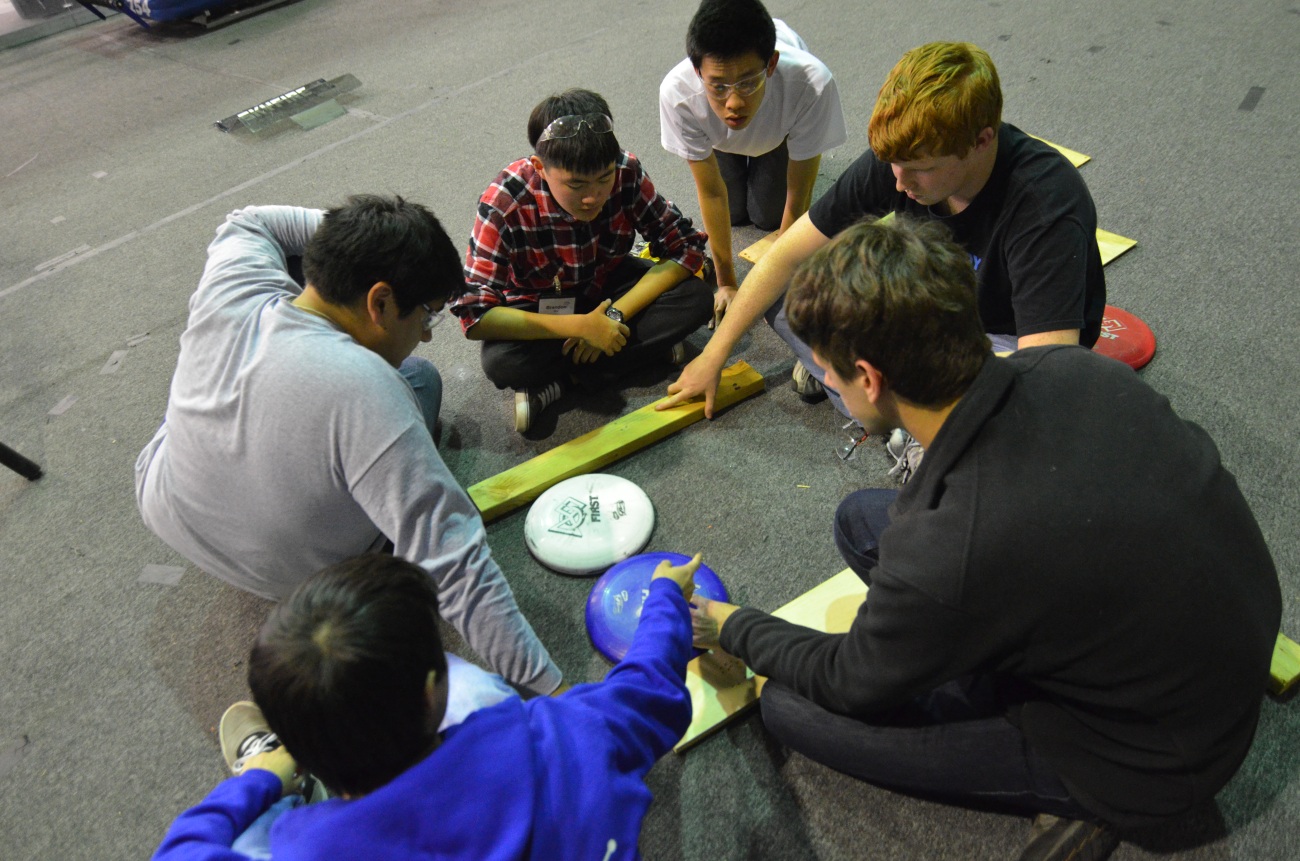
Students built a mock-up human player station. They also determined best way to feed frisbees through the human player station and throw them across the field during the last thirty seconds of a match

Programming

With a new to-do list to keep track of action items, a multitude of programming-related tasks were completed or started.  Students worked on getting constant variables to read from a file for the robot code.  This updating would happen in robotInit(), right as the robot turns on.  They also worked on reading autonomous scripts from a file for the robot in such a manner that these scripts deployable without re-compiling.  Since they don't have the actual autonomous functions yet, programmers have created an initial structure to parse in names of the commands and their parameter(s) from a text file.  The Smart Dashboard was installed on the driver station.  Tomorrow, programmers will work on creating custom widgets to place on the dashboard.  Lastly, programmers imported math functions from the 2012 robot code into the 2013 robot code.


Action Items For Tomorrow:

  • Upgrade Intermediate Conveyor Prototype

  • Upgrade Shooter Prototype

  • Continue Programming (See Richard's Action Item List)

  • Finish Drivebase CAD

Time Left the Lab: 12:00 AM

Day #5: Continued Prototyping

2013 FRC Build SeasonFIRST Robotics#FRC Build Blog

Today was a very productive day at the lab. There was a lot of progress made in many areas.

Prototyping

Shooter Prototype

Improvements were made to the shooter prototype. After students replaced a faulty CIM motor, an adjustable base was added to the linear shooter to allow testing at multiple angles. This base will help optimize the perfect angle for shooting a frisbee. The base was constructed out of kitbot parts and 80-20 extrusion.

D7K_3464

Richard assisting students with the adjustable shooter platform assembly

Intake Prototype

Students worked on improving the roller-intake prototype by testing different kinds of tread spinning at different speeds. It was found (unsurprisingly) that the roller must be spinning very quickly (about 2,000 RPM) to intake the frisbee. Long rough-top tread attached as "fingers" did not work well. A piece of rough-top tread that was wrapped around the roller worked the best.

After determining this improved treading configuration, students and mentors worked on setting up the prototype as an over-the-bumper intake. Rather than sucking-in the frisbee horizontally, tests were conducted to see if the frisbee could make a smooth and easy transition from a horizontal position on the ground to an angled position over the bumper.

D7K_3465

Updated Intake prototype

Restoring the 2010 drivebase

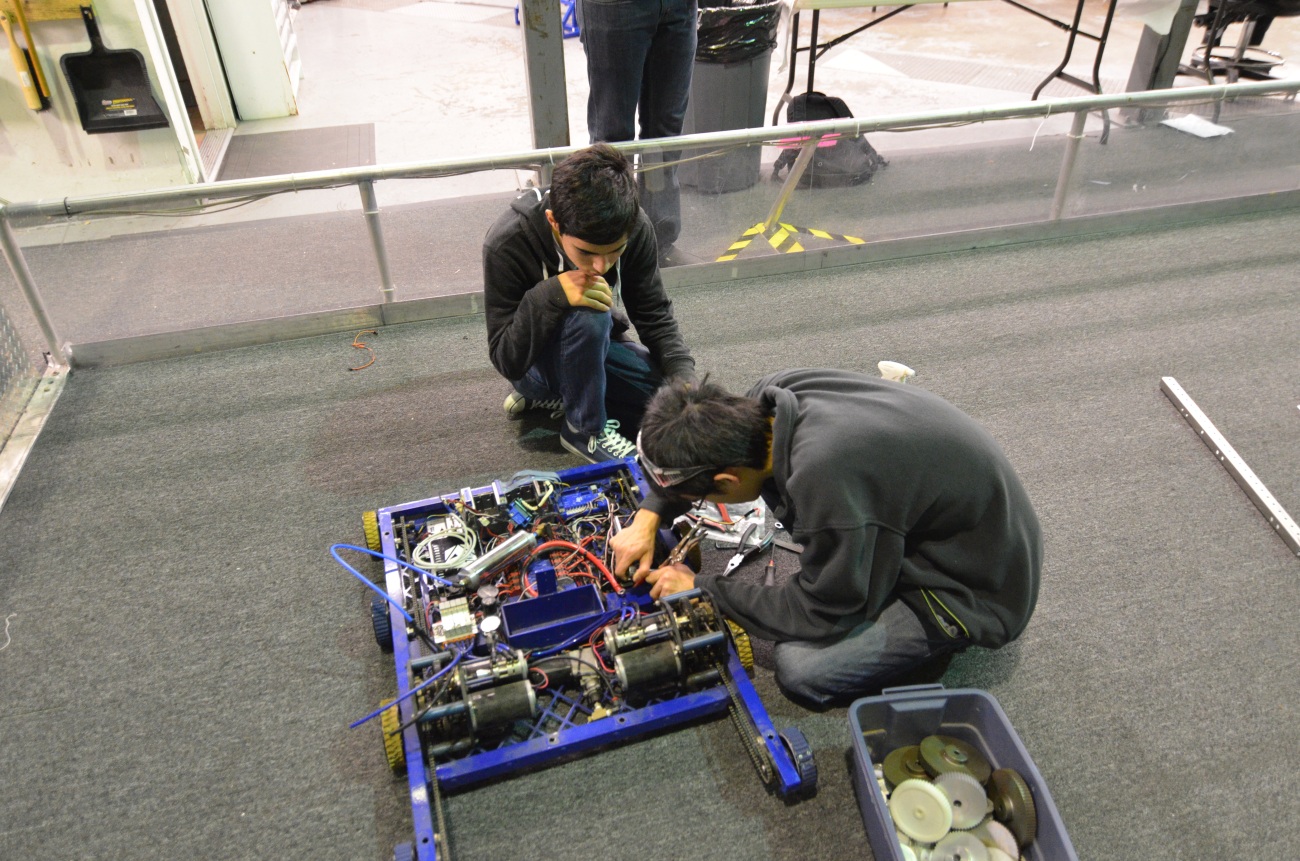
Students continued to attempt to restore the 2010 drive base, in order to attach prototypes and drive around. After an hour of debugging, it was concluded that a faulty cRIO was on the robot. The efforts were abandoned because of a lack of replacement cRIO. Hopefully, a new cRIO is acquired soon in order to continue testing.

Restoring the drivebase was also supposed to be an excercise for the new programmers, so they could practice writing brand new code and uploading it to a functioning robot.

Programming

Tom dropped some knowledge bombs on the programmers today.

Constants


Students continued to brainstorm and discuss possible ways of updating values without having to re-compile or re-deploy the code.  Some ideas that was brought up was having a text file for each constant, or having an "isModified" boolean value somewhere.


Action Item List


An action item specific to programming was created yesterday.  This is essentially a to-do list, which organizes and tracks tasks what need to be completed and the priorities of tasks.  This list should make it easier for students at the lab to more easily contribute to programming effort.


Miscellaneous

Light Control Box

Two students worked on modeling a project box and the components to go inside it. This project box will house a power supply and will be the control box for the lights hanging on the trussing in the pit area.

image

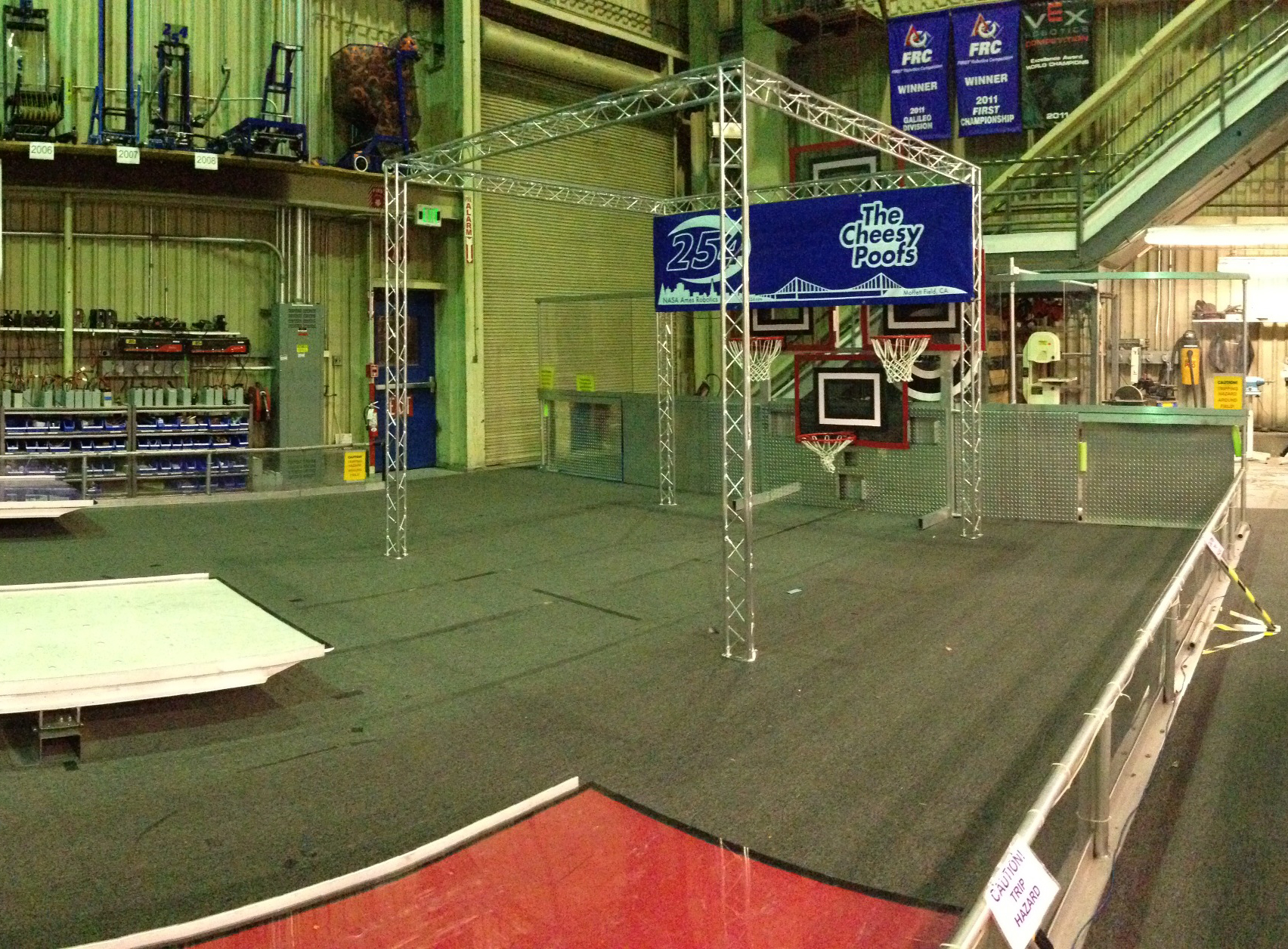
Pit Area trussing for banners, lighting, and monitor mounting

D7K_3466

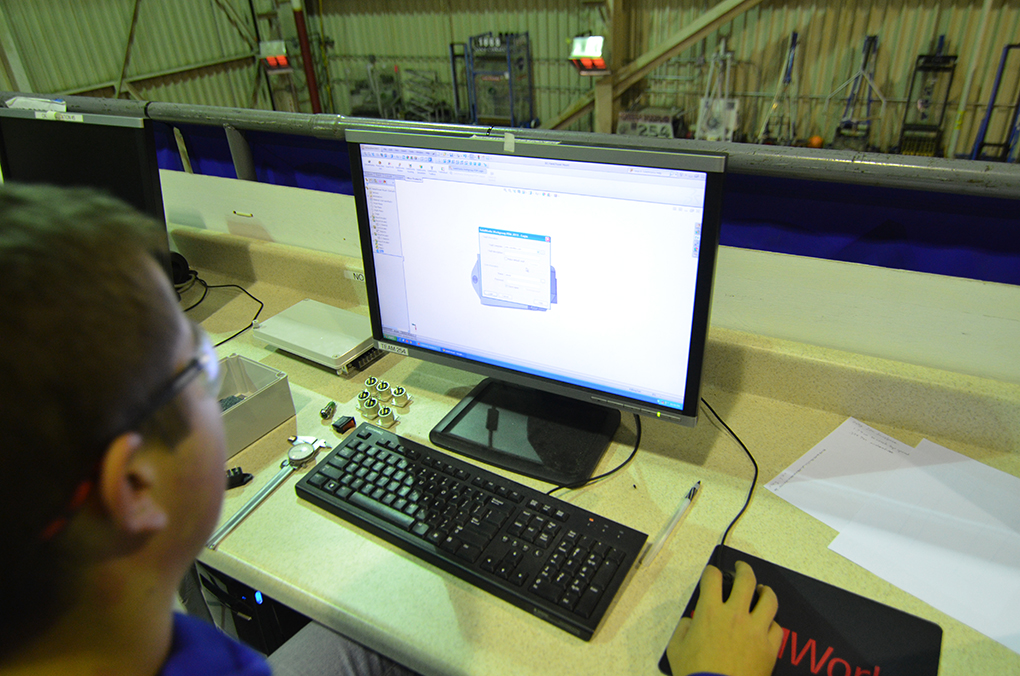
A student modeling the project box in SolidWorks.

Action Items for Tomorrow

  • Fix the wiring to the cRIO on the 2010 robot; flash new image to cRIO

  • Work on and test prototype for intake

  • Work on and test linear shooter prototype

  • Complete drivetrain design. Deadline is Friday.

Lab closing time was 11:00 pm

FRC Programming - Action Items

2013 FRC Build SeasonFIRST RoboticsProgramming

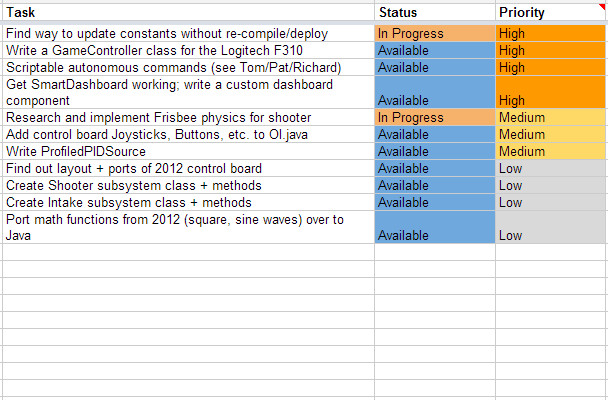
In order to keep track of programming-related action items for FRC, we've created a spreadsheet with tasks that are sorted by priority.  If you're ever at the lab and want to do some programming, swing by and choose a task that interests you.  We hope that this list will make it easier for you to find a cool project to work on while in the lab.  


todo

The action item list, as of Day 5


As always, you can let Richard, Stephen, Tom, or Pat if you have any questions or need clarification.  Be sure to read the blog often to check out our programming progress!

Day #4: Success with Intake and Shooter!

2013 FRC Build SeasonFIRST Robotics#FRC Build Blog

Today was a huge improvement in student attendance over yesterday. With our first active weekday build, a majority of the time was spent designing and beginning initial prototyping of an intake mechanism.

Prototyping

Intake Prototype

Students worked in a group to brainstorm ideas for an intake mechanism that will allow the robot to take in discs from the ground.  One of the several ideas brought up include horizontal rollers to roll the discs in.  However, the orientation of the disc (facing upwards or downwards) and friction between the carpet and the disc are challenges.  Currently, one new intake prototype has been constructed that can take in discs on the ground from either orientation. 

intake

Students brainstorming ideas for the intake

Shooter Prototype

Additionally, some students are continuing work on manufacturing parts for shooter prototypes.  

One new shooter prototype that is under construction is a linear shooter, powered by two wheels.  One wheel will be powered such that it is faster than the other.


manufacturing

Manufacturing parts to build a shooter prototype

Testing Prototypes

Some students are using the drivebase of the 2010 robot, Onslaught, in order to test shooting and future intake prototypes.  Currently, there is a problem with power to the cRIO, which prevents controlling or deploying code to the robot.  Once the 2010 robot is up and running, the team will attach prototypes to the robot to test out prototypes on the field, while driving.


onslaught

Drivebase of the 2010 robot, Onslaught

Programming

Reading Constants

The programmers discovered that original idea to use Java reflection will not work because the robot uses Java ME (mobile edition), which does not support this feature. They brainstormed some other possible solutions including using a hash map for storing variables read from a file, but it is likely unfeasible due to its heavy computational expense. Another idea is to use a flat text file with constant values that can be transferred to the robot without re-compiling and re-deploying code. 

Controls

In addition, the programming team tested out a Logitech game controller as a way of driving the robot.  The analog sticks on the controller were successfully used to control the drive.  More comparisons and tests between joysticks and the game controller will occur later on in the season.

Action Items for Tomorrow

  • Fix the wiring to the cRIO on the 2010 robot; flash new image to cRIO

  • Work on and test prototype for intake

  • Work on and test linear shooter prototype

Lab closing time for the night was 12:30am